
Mastery Maths Curriculum at Le Cateau
How We Teach Mathematics from Year 1 to Year 6
At Le Cateau, we want every child to feel confident, secure and successful in mathematics. To support this, we follow a consistent, research-informed approach across all year groups.
At Le Cateau we use the NCETM Curriculum Prioritisation materials, which provide a clear, structured progression from Year 1 to Year 6. In Years 1 to Year 5, children also take part in daily NCETM Mastery Number (Fluency) sessions to strengthen early number sense and fluency. For more information about the NCETM, please follow this link;
What is NCETM?
The NCETM is the National Centre for Excellence in the Teaching of Mathematics, supporting schools and teachers across England to develop pupils’ deep, secure understanding of mathematical concepts rather than relying on quick tricks or memorised methods.
What is Curriculum Prioritisation?
The Curriculum Prioritisation is a structured version of the maths curriculum created by the NCETM to support teaching in small, connected steps. It ensures pupils master essential ideas before progressing to more complex concepts and helps schools sequence learning effectively by identifying what to teach first, which concepts matter most, and how to secure deep mathematical understanding.
How it works
The NCETM organises the maths curriculum into carefully sequenced ‘spines’, each focusing on a key area of learning such as:
- Number, Addition and Subtraction
- Multiplication and Division
- Fractions
- Geometry and Measure
- Statistics
Each spine is broken down into small Prioritised Teaching Points that guide teachers to spend longer on the most important concepts, give pupils time to practise and reason mathematically and address learning gaps before new content is introduced.
Why is it helpful for children?
The Curriculum Prioritisation supports children by:
- Building confidence through logical, manageable lesson steps
- Developing genuine understanding rather than memorisation
- Helping them make meaningful connections across concepts such as multiplication and division or fractions, division and decimals
It ensures all pupils learn together at a steady pace, with additional support provided where needed, so that children keep up rather than catch up.
What does this mean for your child?
In Years 1 and 2, children build strong foundations in number by:
- Developing secure number sense through practical equipment, diagrams and visual models
- They learn key early concepts such as number bonds, subitising, counting patterns
- The beginnings of multiplication and division, helping them understand what numbers mean and how they relate to one another
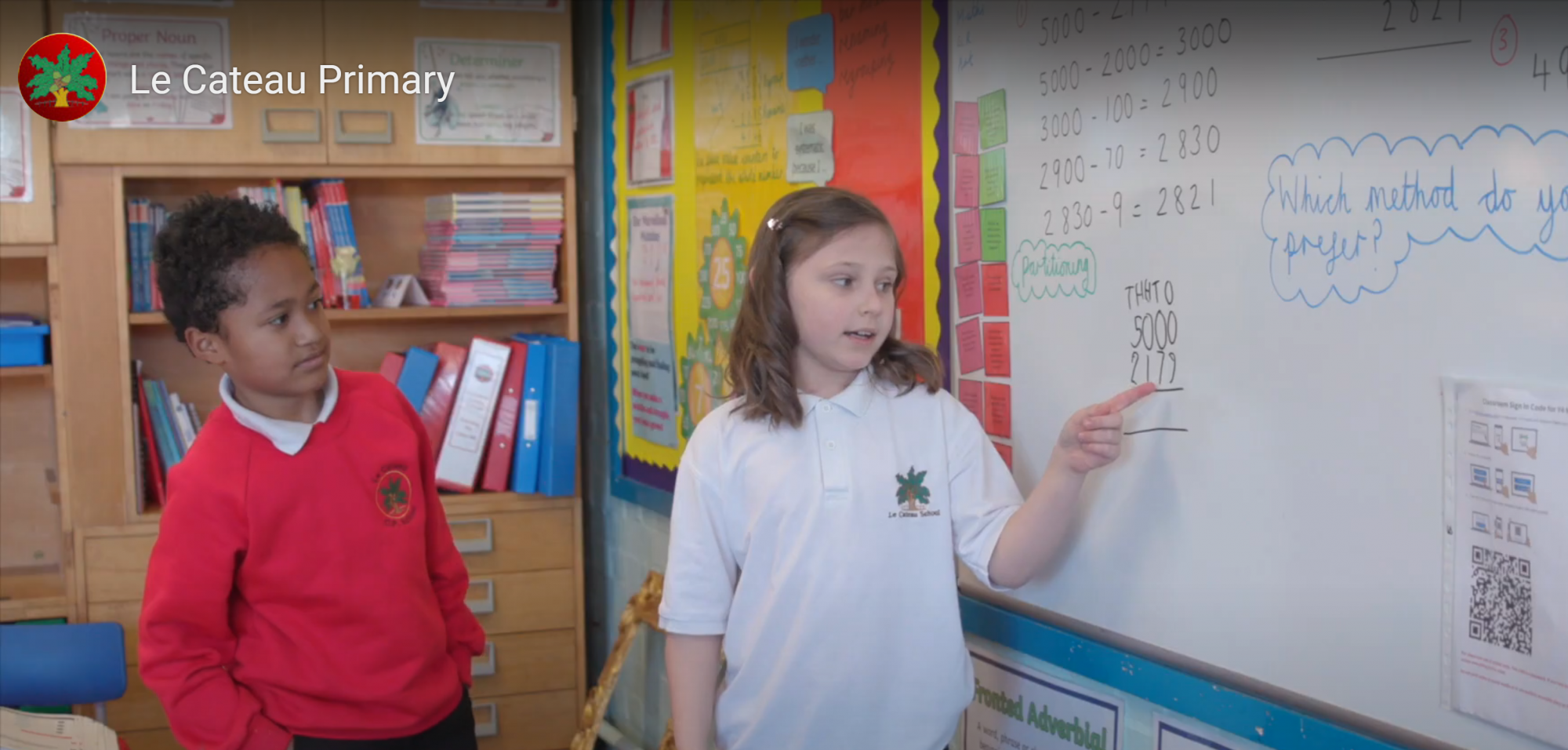
From Year 3 onwards, children build confidence as they move gradually towards formal written methods, introduced only when they fully understand the underlying concepts.
By the end of Year 6, pupils can confidently use column addition and subtraction, short and long multiplication, short and long division, a range of fraction, decimal and percentage calculations, and apply ratio, proportion and early algebra with secure understanding.
Why do children use diagrams and equipment?
Children use diagrams and equipment such as tens frames, number lines, part–whole models, arrays, bar models and place value counters to help them understand the meaning behind calculations. These representations are essential for developing deep conceptual understanding, not shortcuts. As pupils become more confident and secure in their thinking, they naturally move towards more formal written methods.
How parents can support at home?
You can support your child’s maths learning by:
- Encouraging them to explain their thinking
- Practising number bonds and times tables regularly
- Making maths part of everyday life through activities such as counting change, measuring ingredients or spotting shapes
- Focusing on developing understanding rather than speed
What if my child needs extra support?
All pupils follow the same curriculum. Support is provided through:
- Practical equipment
- Small-step teaching
- Guided practice
- Pre-teaching
- Extra fluency rehearsal
- Targeted Interventions for individuals or groups
If you have concerns, please speak to your child’s class teacher.
What if my child needs more challenge?
Challenge is provided through depth, not acceleration. This means:
- More complex reasoning
- Explaining and justifying methods
- Spotting patterns
- Solving multi-step problems
- Making generalisations
Want to know more?
You can read the calculation policy for each year group or visit the 'curriculum map and expectations' by using the following links;
What is Fluency In Number?
We also recognise the importance of fluency in maths. Fluency skills in maths is about number sense and being able to select the most appropriate/efficient method for the task at hand; to be able to apply a skill to multiple contexts. The National Curriculum states that pupils should become fluent in the fundamentals of mathematics through varied and frequent practice. While a part of this is about knowing key mathematical facts and recalling them efficiently, fluency means so much more than this at it allows pupils to delve much deeper.
For learning to be retained and reactivated, pupils need opportunities for retrieval and rehearsal. Our pupils carry out daily fluency tasks designed to allow pupils time to remember, practice and secure, the learning necessary to be successful in mathematics. As a school, we are part of the NCETM Mastering Number Program and implement this structure across the school. The fluency program for each year group can be found in the Year Group dropdown menu at the side of this page.
What is the Mastering Number Project?
Following the successful implementation of the a Mastering Number program in FS2 (Reception), Year 1 and Year 2 securing firm foundations in the development of good number sense, we are delighted to be working with the Yorkshire Ridings Maths Hub to introduce Mastering Number in Key Stage 2. The aim over time is that children will consolidate additive fluency skills and move into multiplicative number sense developing their confidence and flexibility with number.
As the program evolves pupils will:
- Develop fluency in calculation and a confidence and flexibility with number that exemplifies good number sense
- Be able to clearly communicate their mathematical ideas
- Make good progress towards the Early Learning Goals and Year Group Expectations
- Demonstrate a positive attitude towards maths
- Demonstrate a willingness to ‘have a go’